

Published · 12 minute read
Is Yonder worth it? My Yonder credit card review, 8 months in (2026)
Ad Links marked Ad are my referral links.
TL;DR
I’ve held Yonder’s paid tier, called Full until it became Premium in September 2026, for eight months and redeemed 71,170 points for £241 of rewards. That works out at 0.339p per point, not the 2.5p Yonder advertises or the 0.5p most reviews repeat. At Premium’s new £17.99 a month, it only beats the free tier above roughly £1,330 a month of card spending, or about £880 if your rent or mortgage goes through Yonder. Here’s the full ledger.
If you just need the link, you can get your Yonder referral code here.
Affiliate disclosure: this post contains a Yonder referral link. Joining Premium (formerly Full) through a referral link gets you £10 off your first purchase, two months with the £17.99 fee waived, and tiered welcome points. Joining Free gets you £10 off and a smaller tier of points. I receive points if you join. I also carry a British Airways Amex Classic referral link, and the Amex comparison below links to the page that holds it, so I earn Avios if you take the card I say might suit you better. Yonder sets referral terms inside the app, they’re personal to each member and they change often, so treat any fixed figure you read elsewhere with suspicion, including mine. None of it affects what you pay.
Short answer: Yonder Premium, called Full until September 2026, is the best rewards credit card I’ve used, but a Yonder point is worth about 0.339p in practice, not the 2.5p Yonder advertises. At my real redemption rate, paying £17.99 a month for Premium only beats the free tier above roughly £1,330 a month of card spending, or about £880 if £2,000 a month of rent or mortgage goes through Yonder too. Below that, take the Free card and keep the £216.
I joined Yonder on the Free card in mid-2025 and upgraded to Full in December 2025. In the eight months since, I’ve redeemed 71,170 points for £241 of rewards. Every number in this review comes from my own account or from Yonder’s own published documents, and where I haven’t tested something I say so. On 21 September 2026 Yonder renamed Full to Premium and raised the fee from £15 to £17.99 a month. The maths below uses the new price, because that is what you would pay.
That matters more than usual here, because almost every Yonder review on the web repeats a points valuation of 0.5p, five times the only rate Yonder guarantees in writing.
What eight months on Yonder Full actually produced
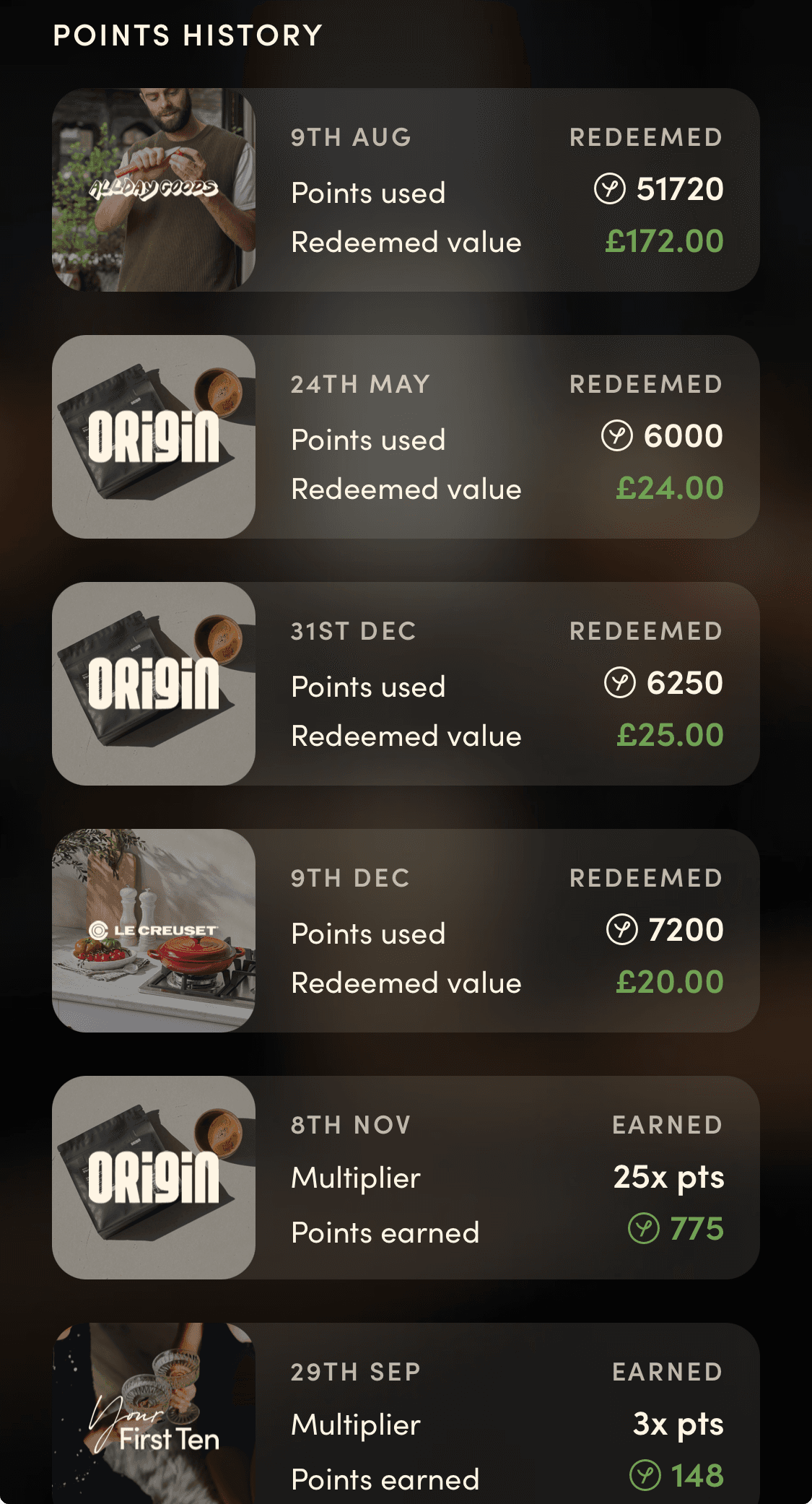
Here is my complete redemption history. Four redemptions: two coffee orders, a set of mugs and a knife set.
| Date | Partner | Points spent | Value received | Rate achieved |
|---|---|---|---|---|
| 9 Dec 2025 | Le Creuset | 7,200 | £20.00 | 0.278p |
| 31 Dec 2025 | Origin Coffee | 6,250 | £25.00 | 0.400p |
| 24 May 2026 | Origin Coffee | 6,000 | £24.00 | 0.400p |
| 9 Aug 2026 | Allday Goods | 51,720 | £172.00 | 0.333p |
| Total | 71,170 | £241.00 | 0.339p |
The blended rate across those four redemptions is 0.339p per point. Hold on to that number, because the rest of this review is what happens when you apply it to Yonder’s own marketing.
The last row is new, it is by far the largest thing I have done with the points, and it moved the rate the wrong way. On 9 August 2026 I put 51,720 points against a £220 knife set from Allday Goods, which covered £172 and left £48 to pay:
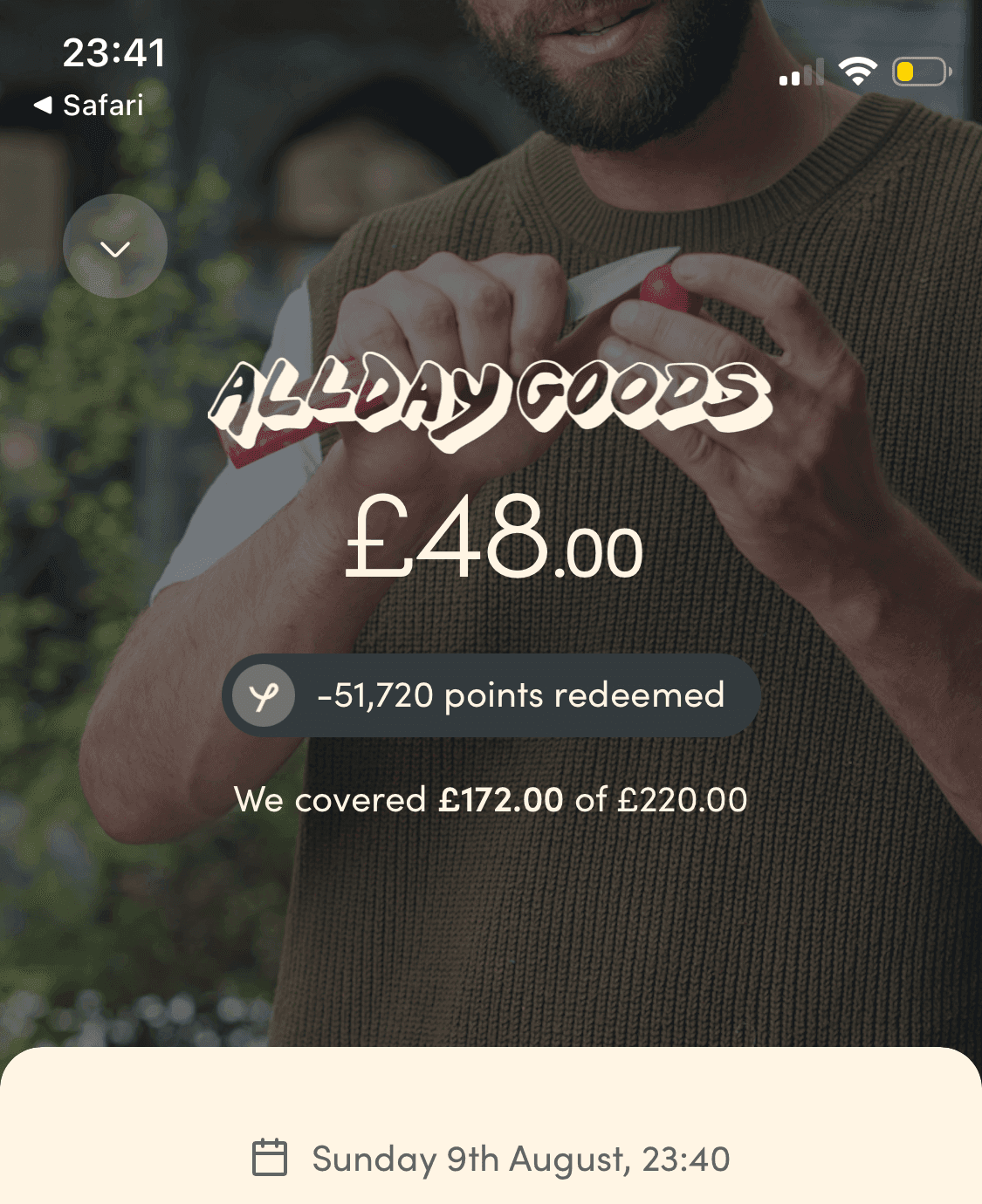
That single redemption is 73% of every point I have ever spent, and it priced at 0.333p, below the 0.355p my first three had averaged. So the headline rate on this page fell when I finally made the big redemption I had been saving for. That is the honest shape of a curated catalogue: the small rewards priced best, and the one item I actually wanted most priced worst.
What a Yonder point is really worth
There are at least six different answers to “how much is a Yonder point worth”, depending on who you ask. Five of them come from Yonder, and every one is collected and sourced in what a Yonder point is really worth.
| Where the number comes from | Value per point | vs my rate |
|---|---|---|
| Yonder’s marketing, “up to 2.5p” | 2.5p | 7.4× |
| Yonder’s app, valuing my balance | 0.5p | 1.5× |
| What most UK reviews repeat | 0.5p | 1.5× |
| What I’ve actually achieved, four redemptions | 0.339p | my rate |
| The knife set I redeemed, 51,720 pts for £172 | 0.333p | 1.0× |
| Against a flight, 31,250 pts for £50 | 0.16p | 0.5× |
| Cashing out, the only rate in writing | 0.1p | 0.3× |
Source: Yonder, September 2026. Seb Place, Yonder app, August 2026. Seb Place, survey of UK Yonder reviews, July 2026. Seb Place, Yonder redemption ledger (71,170 points for £241.00), August 2026. Yonder Rewards Terms & Conditions 2.3, section 4(b), September 2026.
The bottom row is the one nobody quotes. Yonder’s Rewards Terms & Conditions (opens in new tab) state it plainly in section 4(b): “100,000 Points is worth £100”. That is 0.1p per point, it applies only to Premium members, and it’s the only conversion rate Yonder commits to contractually. Free members can’t cash out at all.
So the marketed rate is seven times my lived rate, and twenty-five times the guaranteed floor.
The app is more conservative than the marketing, but still optimistic. On 25 July 2026 it told me my 72,640-point balance was worth £363.20:
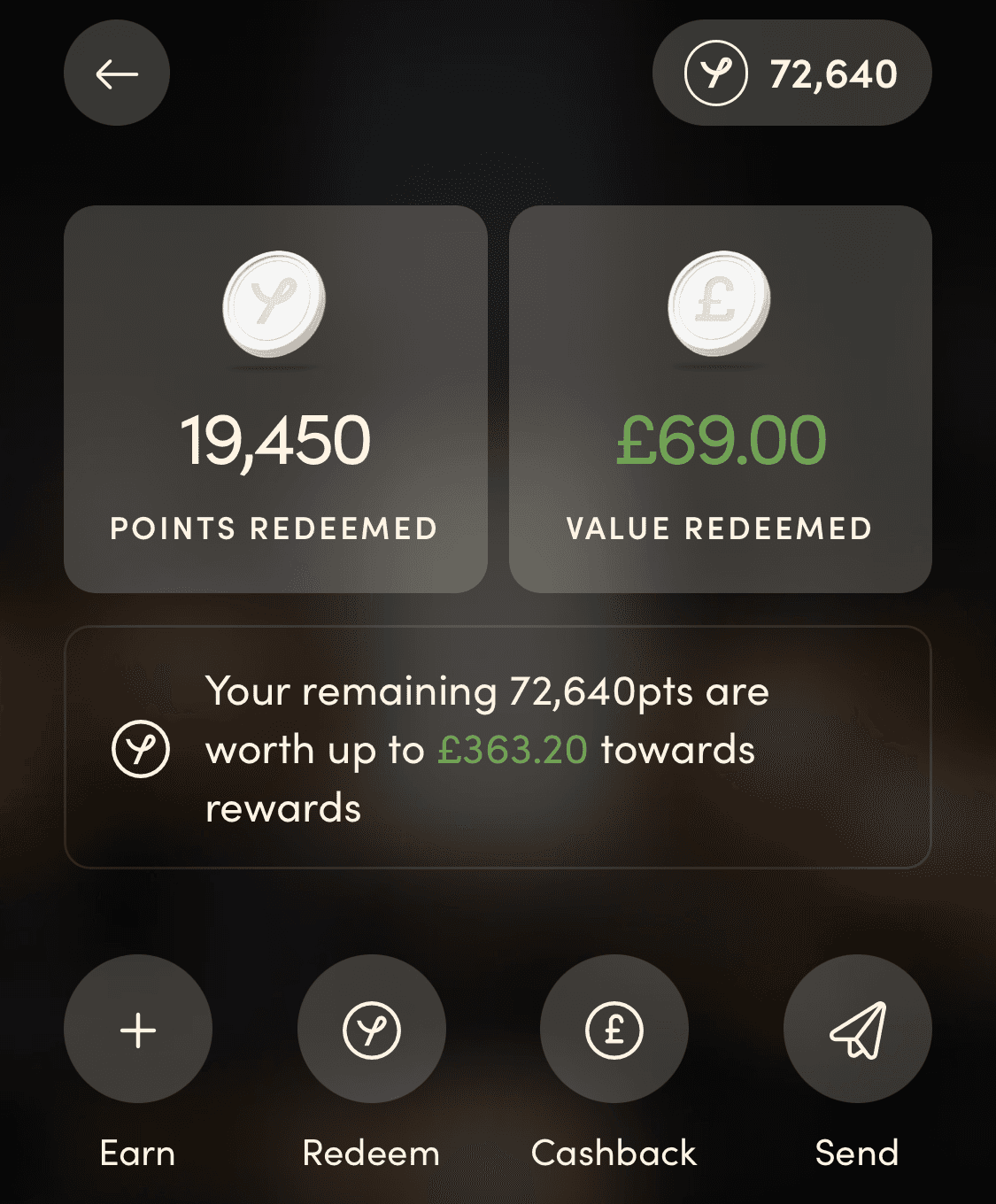
£363.20 across 72,640 points is exactly 0.5p per point. Two weeks later I got to test that projection against a real redemption, which is something most points valuations never get to do.
Of the 72,640 points on that screen, 51,720 went on the knife set. The app had priced them at £258.60. They returned £172.00. It had overstated the only part of that balance I have since spent by 50%, using a rate no redemption in my account has ever reached.
To be fair to Yonder, the words “up to” are doing a lot of work in both places, and two of my redemptions did reach 0.4p. But “up to 2.5p” sets an expectation that nothing in my account has come close to.
Where the “10,000 points is £50” figure comes from
Almost every UK review and comparison page values Yonder points at 0.5p, usually phrased as 10,000 welcome points being worth about £50. Yonder’s own worked example is where that comes from, and it doesn’t survive contact with its own headline rate: the rewards page says spending £1,250 a month earns 75,000 points a year, and that “when used at 2.5p towards Experiences, you’ll get back around £375 in value”.
75,000 points at 2.5p is £1,875, not £375. £375 is 75,000 points at 0.5p. The sentence contains both numbers and they’re five times apart.
If you want the durable version: 10,000 Yonder points is £10 if you cash out, about £16 against a flight, and £28 to £40 across the redemptions I have actually made. It is not £50.
Does Yonder Premium beat Yonder Free?
This is the only question that matters, and it’s the one most reviews skip by comparing Yonder to “nothing”. Both tiers are Mastercards, both charge no foreign transaction fees, both are FCA regulated, and both use the same app.
An earlier version of this review said everything beyond the fee and the earn rate was identical. Re-checking Yonder’s own comparison table on 28 July 2026, and again on 22 September 2026 after Full became Premium, that was too strong. The differences are:
| Yonder Free | Yonder Premium | |
|---|---|---|
| Monthly fee | £0 | £17.99 (or £190 a year) |
| Points per £1 | 1 | 5 |
| Points on rent or mortgage | 200 a month | 1 per £1, up to 2,000 a month |
| Travel credits | none | £140 a year |
| Points per £1 at Experiences | up to 5 | up to 25 |
| Experiences catalogue | some | all |
| Points for statement credit | no | yes, at 0.1p |
| Points towards flights | no | yes |
| Worldwide travel insurance | no | yes |
| Fee-free cash withdrawals abroad | no | up to £200, see below |
| Foreign transaction fees | none | none |
So the fee buys four extra points per £1 plus a handful of benefits, and the honest way to run the maths is points first, benefits second, because only the points scale with how much you spend.
On points alone: four extra points per £1, at my real 0.339p, is 1.36p of value per £1 spent. To cover Premium’s £215.88 a year at £17.99 a month you need to put roughly £15,900 a year, or £1,327 a month, through the card. Pay the £190 annual rate instead and that falls to about £1,170 a month.
Annual value after fees
| Monthly spend | Extra points a year | Premium vs Free |
|---|---|---|
| £400 | 19,200 | −£151 (Free wins) |
| £750 | 36,000 | −£94 (Free wins) |
| £1,100 | 52,800 | −£37 (Free wins) |
| £1,327 | 63,696 | £0 (breakeven) |
| £1,500 | 72,000 | £28 (Premium wins) |
| £2,000 | 96,000 | £110 (Premium wins) |
| £3,000 | 144,000 | £272 (Premium wins) |
Source: Seb Place, Yonder redemption ledger (71,170 points for £241.00), August 2026. Yonder, September 2026.
I put over £2,000 a month through the card, so on my old £15 a month Full has been worth about £145 a year more to me than Free would be. At Premium’s £17.99 that falls to about £110. Existing members like me stay on £15 until Yonder moves us over later in 2026, and can lock in the old £160 annual price for one more year until 21 November 2026, which at my spending is worth £165 over Free, £56 more than paying monthly at the new price. That’s a real gain and it’s why I keep paying. It is also a lot less than the card’s marketing implies, and at the new price it evaporates completely somewhere around £1,330 a month.
Yonder now says Premium is “worth £870 a year”, on £1,500 a month of card spending and £2,000 a month of rent or mortgage at its maximum redemption rates. That figure reconciles, to within £1, to 114,000 points at 0.4p (£456), the travel insurance at Yonder’s own £275 valuation and the credits at their full £140. At my 0.339p the same assumptions come to £801, and only £386 of that is points: the other £415 is worth whatever you would otherwise pay for insurance and whatever you would actually book with the credits.
An earlier version of this review put that breakeven at £750 a month. That figure was calculated at 0.5p per point, the same inflated rate everyone else uses. At my actual redemption rate the true threshold is about 50% higher, which means anyone spending £800 a month was being told to buy Full when the free card would leave them better off. Correcting it is the main reason this review was rewritten.
Five things move the line in your favour:
- Rent or a mortgage paid through Yonder. New since September 2026, and the biggest lever for most households: Premium earns 1 point per £1 on up to £2,000 a month of rent or mortgage, against Free’s flat 200 points a month. At £2,000 that is worth about £73 a year more at my rate, which brings the threshold down to about £880 a month of card spending. New Premium members earn 5 points per £1 on it, capped at 10,000 a month, until 31 December 2026. Yonder takes the money from your own bank account and pays your landlord or lender by standing order, so you are not borrowing.
- The travel insurance, if you would otherwise buy it. Premium includes worldwide travel insurance, which Free does not, and Yonder markets it at £275 a year. I hold it and have never claimed on it, so I can’t tell you what the claims experience is like, and I’d treat the £275 as a marketing figure rather than a price you were definitely going to pay. But if you genuinely buy annual travel cover every year, its real cost to you comes off the £216 and the spending threshold drops accordingly. This is the strongest argument for Premium that has nothing to do with points, and it’s the one I’d underweighted.
- The travel credits, if you would use them. Premium now adds £50 every six months towards a Yonder hotel or a Hertz car and £20 every six months at No.1 Lounges, £140 a year in all. Each needs a minimum spend, none roll over, and Yonder’s Rewards Terms rule them out during a free trial. If you would book those twice a year anyway, they cover most of the fee on their own; if you wouldn’t, they are worth nothing.
- Partner multipliers. Some Yonder partners pay far more than the standard 5 points per £1. One Origin order in my history earned 775 points at a 25x rate. If a meaningful share of your spending lands at partner venues, your effective earn rate is higher than the table assumes.
- Redeeming well. Every row above uses my blended 0.339p. My best redemptions hit 0.4p, and if you consistently manage that the breakeven falls to around £1,120 a month.
And one that moves it against you: if you plan to cash out rather than redeem on rewards, Premium never beats Free. At 0.1p, four extra points per £1 is worth 0.4p, and £216 of fees needs about £54,000 of annual spending to recover.
What I actually redeemed on
This is where my experience diverges from every other Yonder review I’ve read.
Yonder markets itself on restaurant tables and city experiences. I have redeemed on coffee beans twice, a set of Le Creuset mugs and a set of kitchen knives. I have never used it to book a restaurant. My redemptions have been physical goods, delivered, and that’s the part of the catalogue I actually want.
The knives are the one worth walking through, because they are the only large redemption I have made. Here is the reward as the app listed it in July:
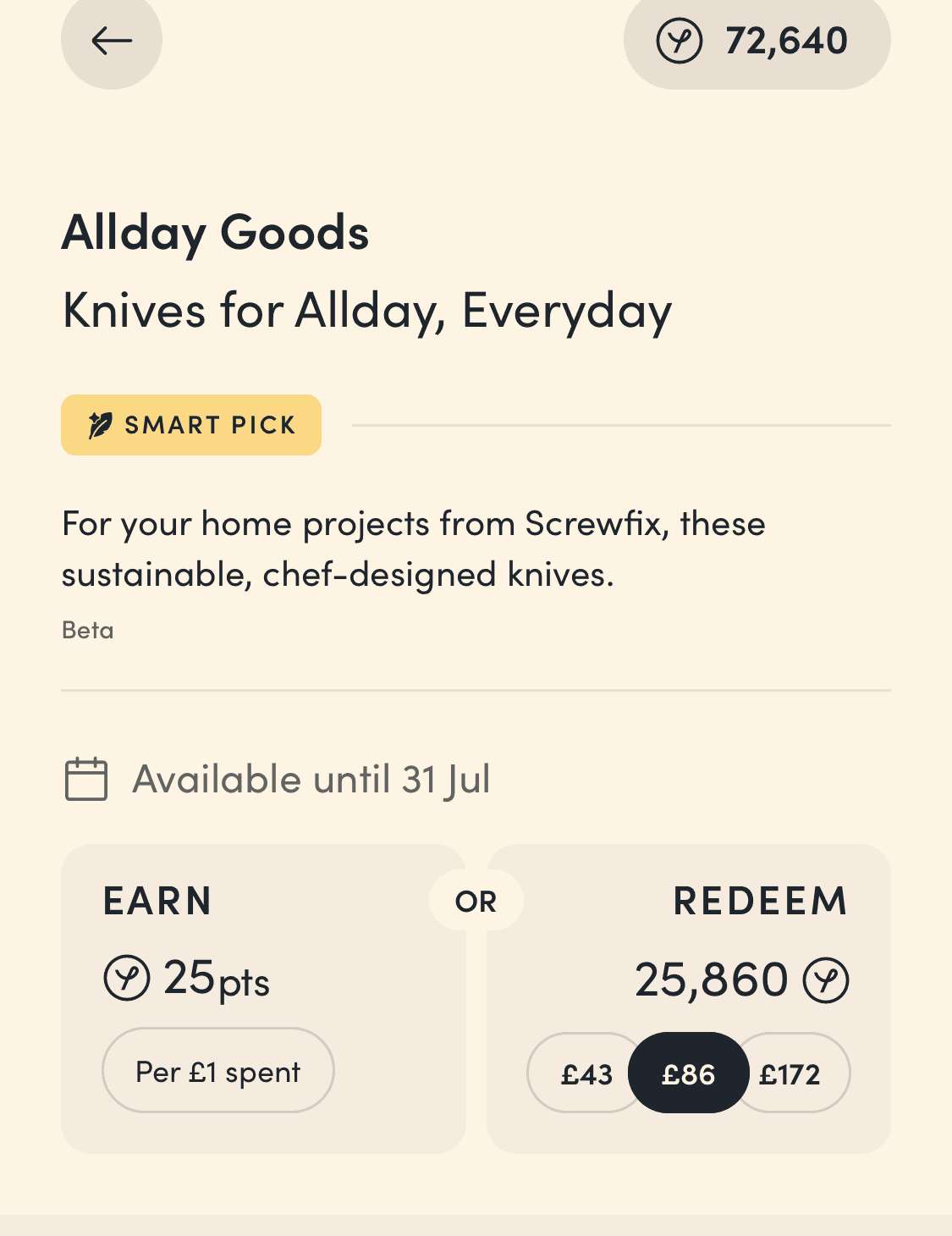
I took the top tier on 9 August 2026: 51,720 points against a £220 set, covering £172 and leaving £48 to pay. A £220 knife set for £48 is a genuinely good outcome and it is the single best use I have found for the points. Note the rate though. Every tier on that screen prices at 0.333p, so the reward I wanted most was also the worst-value thing in my own ledger.
Three details from that screen worth flagging.
The reward is tagged “Smart Pick”, with the explanation “for your home projects from Screwfix”. Yonder read my Screwfix transactions and inferred I’d want kitchen knives. It worked, which is the unsettling part.
It was marked Beta and “available until 31 Jul”. I redeemed it on 9 August, nine days after the date the app had shown me. The deadline turned out to be soft, which is a good outcome and not one to plan around: a catalogue that can move a date in your favour can move one against you.
The tiers are flat, so there is no reward for saving. £43, £86 and £172 all price at the same 0.333p. Holding out for the big tier bought me a bigger reward, not a better rate, and the eight months I spent accumulating the balance earned nothing at all.
The eight months I spent not redeeming
Between December and August I redeemed £69 of rewards while the balance climbed past 72,000 points. Then I spent 51,720 of them in one go. The day after, the balance read 36,715, already halfway back to where it had been before the redemption. That gap, and the speed it refills at, is the most useful thing in this review, so here’s the explanation rather than an excuse.
I forget to look. Points don’t expire, nothing prompts me, and the rewards catalogue is somewhere I have to choose to visit. Some of the balance was deliberate saving for the knives, but a lot of it was simple inertia, and the knife tiers above show that the saving half earned me nothing the spending half would not have. This is a real and under-reported cost of points cards: the value is contingent on effort you may not put in, whereas a cashback card pays you whether you engage or not.
The catalogue leans away from how I want to spend. My main criticism of Yonder is that it’s experience-heavy. I want to buy things. The dining and events side is clearly the priority, and the physical goods side, which is the part I use, is thinner. If Yonder expanded the goods catalogue I’d redeem far more often, and my effective rate would probably rise with it.
The near-miss notifications. If I spend at a pottery shop and there’s a Yonder partner pottery shop nearby, I get a notification afterwards telling me I could have saved £x by shopping at the partner instead. It’s useful information delivered at the least useful moment. It also makes the point that capturing the advertised value requires routing your spending around Yonder’s partner list, not just paying with the card.
What I haven’t hit: no declines, no rewards vanishing before I could book them, no credit limit problems at over £2,000 a month of spending, and no trouble with the app.
Yonder vs the BA Amex I stopped using
I held a British Airways Amex before Yonder and still have the account, though I rarely use it. I was putting £1,500 a month through it and never accumulated enough Avios to redeem on anything worthwhile.
The arithmetic explains why, and it isn’t flattering to Yonder in the way you’d expect.
The free BA Amex Credit Card earns 1 Avios per £1 (opens in new tab). At £1,500 a month that’s 18,000 Avios a year. Avios are commonly valued at around 1p each, so call it £180 a year, from a card with no fee. The same £1,500 a month on Yonder Premium earns 90,000 points, worth about £305 at my rate, but £89 after the £17.99 monthly fee.
On paper, the free Amex wins. Its points are worth roughly three times as much each, and it costs nothing to hold.
In practice I redeemed £0 from Amex and £241 from Yonder, and the reason is denomination. Avios arrive in a currency you can only spend in large, awkward blocks: you need a big balance, you need reward availability on the route and date you want, and you still pay fees. A year of solid spending buys roughly one short-haul flight, if the seat exists. Yonder rewards start at around 6,000 points, which is a bag of coffee I’ll actually order.
A 0.339p point you spend beats a 1p point you never spend. That is the entire case for Yonder over Amex, it’s why I rate it 4.5 out of 5 despite everything above, and it’s a personal answer rather than a universal one. If you fly BA regularly and will genuinely chase reward availability, Avios are worth more than Yonder points and the free Amex is the better card.
The other difference is acceptance. Amex gets refused in a fair number of places. Yonder runs on Mastercard and has always worked for me.
There’s a fuller comparison in my Yonder vs Amex Gold breakdown, and if the BA Classic is the card you land on, the BA Amex referral code is worth 6,000 Avios against the 5,000 you get applying direct.
What I haven’t tested
Most Yonder reviews present the travel case as the strongest reason to get the card. I can’t verify it, so I’m not going to pretend otherwise.
I have never used Yonder abroad. No foreign transactions, no holidays on it. Yonder charges no foreign transaction fees on either tier and uses the Mastercard rate, which is verifiable from Yonder’s own card pages (opens in new tab), but I haven’t put it to the test and can’t tell you what the rate felt like in practice.
I have never booked a dining Experience, which is the flagship use case. My view of the catalogue is a goods-buyer’s view.
I have never redeemed against a flight, so the 0.16p figure is from Yonder’s published rates rather than my account.
I have never cashed out, so the 0.1p figure is from the terms rather than experience.
I have never transferred points to an airline. Yonder has since added Cathay Pacific as its first conversion partner, at 5 Yonder points to 1 Asia Mile. That’s a genuinely new redemption route that didn’t exist when I started this ledger, and none of my numbers include it.
None of my numbers include the new Premium benefits. The travel credits and the rent and mortgage points launched on 21 September 2026, six weeks after the last redemption in my ledger.
One structural point falls out of this. No foreign transaction fees on card payments applies identically to Free and Premium. It is therefore not an argument for paying £17.99 a month, even though it’s regularly presented as the headline reason to get Yonder. If FX-free card spending abroad is what you want, the Free card gives you all of it for nothing.
The one genuine travel difference is cash. Yonder’s comparison table lists fee-free withdrawals abroad as a Premium benefit, at £200 a day, and gives Free none. Its credit agreement is stricter, charging 2% on ATM withdrawals above £200 in a membership month, so plan on the monthly figure. If you take cash out on holiday rather than tapping, that belongs in the Premium column. I don’t, so it’s worth nothing to me.
Worth it if, skip if
The maths first, because it doesn’t depend on what kind of person you are:
- Under about £1,330 a month on the card: take Yonder Free, unless £2,000 a month of rent or mortgage goes through Yonder, which lowers the bar to about £880. Premium’s extra points won’t cover £216 a year on card spending alone. This is most people. The other exceptions are annual travel insurance you’d otherwise buy and travel credits you’d actually use, which Premium includes and Free doesn’t: net those off and the threshold drops.
- Over about £1,330 a month, and you’ll actually redeem: Premium pays. At £2,000 a month it’s worth roughly £110 a year to me at the new price.
- Planning to cash out rather than redeem: take Free, at any spend level. At 0.1p, Premium never catches up.
Then the part that depends on you. Splitting it by what I can and can’t vouch for:
Premium is worth it, and I can vouch for this firsthand, if: you spend comfortably above that £1,330 bar on credit, you like buying good physical things and will happily take £24 of coffee or £172 off a knife set, and you’re coming from a card whose points you never got round to redeeming. That’s my situation and Premium clears the bar.
Premium may well suit you, but I can’t vouch for it: if you’re a frequent big-city diner who’ll use the restaurant Experiences, or a frequent traveller who values FX-free spending. Both are plausible and both are what Yonder is built for. I’ve done neither, so take my view on those from the numbers, not from experience. Note again that the FX benefit is free on the Free card.
Skip Yonder Premium if: you want predictable cashback with no effort, you spend under about £1,330 a month on the card and pay no rent through Yonder, you’d cash points out, or you’re a committed Avios collector who’ll chase reward availability. A flat cashback card pays you whether or not you remember it exists, and after the new fee my Yonder return works out around 0.8% of spend, which is not obviously better.
Yonder Free remains close to a no-brainer for anyone who wants a fee-free rewards Mastercard with no foreign transaction fees. There’s no real argument against holding one.
The referral offer, and why you shouldn’t trust a fixed number
Yonder’s public referral terms (opens in new tab) set the rules but publish no figures. The figures are shown inside the app, they’re explicitly personal to each member, and they change. The fine print on my own referral screen in July 2026 said the reward “is personal to you and subject to change”; by August that line had been replaced with a link to those terms.
That means every article quoting a fixed Yonder referral figure, including the ones ranking above this one, is quoting a number that was true for somebody, once.
The durable structure, which has been stable for as long as I’ve held the card:
- £10 off your first purchase
- Two months free on Premium, waiving £35.98 of fees at £17.99 a month (Free has no fee to waive)
- Tiered welcome points, unlocking progressively as your spending in the first 30 days passes £200, £500 and £1,000
The specific point totals move, and I have now watched them move. In July 2026 my link offered a new Full member up to 20,000 points, carried a 1 August 2026 deadline, and gave me a 1% chance of 100,000 points for referring you. When I re-checked the same screen on 1 August 2026, the offer to you was unchanged and the deadline had simply gone, but the prize draw had been withdrawn and my own reward now depends on you making five purchases. On 22 September 2026, the day after Full became Premium, the £10 and the two free months were still on my screen. Check the offer you’re actually shown at sign-up rather than trusting any number in any article, this one included.
Worth knowing either way: Yonder’s card pages advertise the welcome points and one free month to everyone, and no longer mention the £10. Against that, what a link adds on Premium is the second free month and the £10, plus points for the referrer. There’s no downside to using one if you were signing up anyway.
Get your Yonder referral code here →
Yonder FAQs
Is Yonder worth it?
Yonder Free is worth it for almost anyone who wants a rewards Mastercard with no monthly fee and no foreign transaction fees. Yonder Premium, at £17.99 a month, is worth it above roughly £1,330 a month of card spending, or about £880 if £2,000 a month of rent or mortgage goes through Yonder too, provided you’ll actually redeem your points on rewards rather than cashing out. I’ve held the paid tier for eight months at over £2,000 a month of spend, and at the new price it’s worth about £110 a year more to me than the free tier.
Is Yonder a good credit card?
Yes, with a caveat about who it suits. It’s the best rewards card I’ve used, mainly because the rewards are attainable at small point balances, so you actually redeem them. The caveat is that the points are worth roughly a seventh of what the marketing implies, and the £17.99 monthly Premium fee only makes sense at high spending or with your rent going through it. The free tier is good for almost anyone.
Can you cash out Yonder points?
Premium members can. Yonder’s Rewards Terms section 4(b) states that 100,000 points is worth £100, which is 0.1p per point and by far the worst way to use them. Free members cannot redeem points for cash equivalent credit at all. Every route is ranked against that floor in how to redeem Yonder points.
Is Yonder better than Amex?
It depends on whether you’ll actually redeem. The free BA Amex earns 1 Avios per £1, and Avios are commonly valued at around 1p, so per point it’s worth roughly three times a Yonder point and costs nothing to hold. But Avios need large balances and available reward seats before they’re worth anything. I spent £1,500 a month on a BA Amex and never redeemed. Yonder rewards start around 6,000 points, so I do redeem. Yonder also runs on Mastercard, which is accepted in many places Amex isn’t.
The bottom line
Yonder Premium is the best rewards credit card I’ve used and I rate it 4.5 out of 5, but I want to be precise about what that means. It beats the cards I’ve held because its rewards are small enough to actually claim, not because its points are valuable. They aren’t especially: 0.339p each, against a marketed 2.5p.
Eight months in I’ve redeemed £241, three quarters of it in a single transaction after months of not getting round to it. I am already sitting on 36,715 points again, and my main complaint is that the catalogue is aimed at experiences when I want to buy things. At the new price Premium still earns me about £110 a year over the free card, because I spend enough to clear the bar.
If you don’t spend over about £1,330 a month, or £880 with your rent going through Yonder, take the Free card. It costs nothing, it waives foreign transaction fees, and on the numbers above it will leave you better off than paying £17.99 a month for points you may never get round to redeeming.
Sources
- Yonder Rewards Terms & Conditions 2.3 (opens in new tab), section 4(b): “100,000 Points is worth £100”, the Free-member cash-out exclusion, the Free vs Premium earn rates, and section 6 on the travel credits, including that none are issued during a free trial. Version 2.3 renames Full to Premium; section 4(b) is unchanged since the 2.0 document this review first cited
- Yonder Rewards (opens in new tab): the “up to 2.5p towards an Experience” claim and the £1,250-a-month worked example
- Yonder Premium Credit Card (opens in new tab) and Yonder Free Credit Card (opens in new tab): fees, the £190 annual fee option, earn rates, representative APRs, foreign transaction fees, the travel credits, the “worth £870 a year” claim and the Free vs Premium feature table, re-checked 22 September 2026
- Yonder: your biggest bill just started paying you back (opens in new tab) (21 September 2026): the new Premium price, the £160 lock-in for existing members until 21 November 2026, and the rent and mortgage points
- Yonder Credit Agreement 2.9 (opens in new tab), section 9.5: 2% on ATM withdrawals above £200 in a membership month
- Yonder Referral Terms 1.4 (opens in new tab): the five-purchase condition, with no reward figures
- Yonder: points transfers to Cathay Pacific (opens in new tab): 5 Yonder points to 1 Asia Mile, a redemption route I have not used
- Finder: get up to £200 off any flight via credit card points (opens in new tab) (Michelle Stevens, 12 June 2024): 31,250 points covers £50 off a flight
- British Airways American Express Credit Card (opens in new tab): 1 Avios per £1 on the no-fee card
- My own Yonder account: points history, balance and reward screens, captured 25 July 2026; the Allday Goods redemption of 51,720 points for £172.00, transacted and captured 9 August 2026; balance of 36,715 points, 10 August 2026

Referral Plug founder · Personal finance writer and UK consumer savings specialist
I specialise in finding people the best deals to cope with the ever-increasing cost of living. I like to review companies from everyday industries like banking and energy and try to provide a fresh mix of facts and unbiased opinions.
Last verified: October 2026
Griffin Bank Limited, which holds the money on Yonder debit cards, is incorporated in England and Wales (No. 10842931), authorised by the Prudential Regulation Authority and regulated by the Financial Conduct Authority and the Prudential Regulation Authority (FRN 970920). Its paid up capital and reserves exceed £10 million.
Eligible deposits are protected by the Financial Services Compensation Scheme, and eligible complaints can go to the Financial Ombudsman Service.