
11 minute read
Plug-in solar panels UK: the payback, and who pays for export
TL;DR
Worth it facing south at a home that's occupied in the day, marginal on a wall, and being paid for export is a top-up rather than the reason to buy. Plug-in solar has been legal in Great Britain since 27 August 2026, up to 800W through an ordinary socket and one kit per household. On the government's own model, a south-facing kit at a home occupied all day uses 428 of the 690 kWh it makes: £112.66 a year at the October 2026 price cap's average 26.32p a unit, which pays off Octopus's £650 two-panel kit in 5.8 years. Upright on an east- or west-facing wall it takes 9.1 years, close to the 10 after which the government's model, which it calls conservative, replaces the inverter. Being paid for the surplus takes 1.3 to 1.4 years off, and only Octopus offers to pay it: 12p a unit, on a kit bought from Octopus, at a home it supplies with electricity. British Gas, EDF, E.ON Next and OVO neither sell a kit nor offer to pay for one's export.
If you just need the link, you can get your Octopus Energy referral code here.
Affiliate disclosure: this post contains an Octopus Energy referral link. If you switch through it, Octopus pays each of us £50 in bill credit. Referral Plug also earns from EDF and E.ON Next referrals, and from neither British Gas nor OVO, the other two suppliers checked here. I don't own a plug-in kit, and my electricity has been with EDF since July 2026, so nothing below is firsthand: it is arithmetic on figures the government, Ofgem and the suppliers publish, each linked where it was read on 19 October 2026.
Plug-in solar became legal in Great Britain on 27 August 2026. Octopus announced its kits the next day, says its first 500 went in two weeks, and on 19 October showed both of them as sold out "(for now!)". British Gas, EDF, E.ON Next and OVO don't sell one.
Two numbers decide whether a kit pays for itself: how much of its output your home uses as it is made, and whether anyone pays you for the rest. The government's impact assessment publishes the first. The second depends on your supplier.
What the law allows
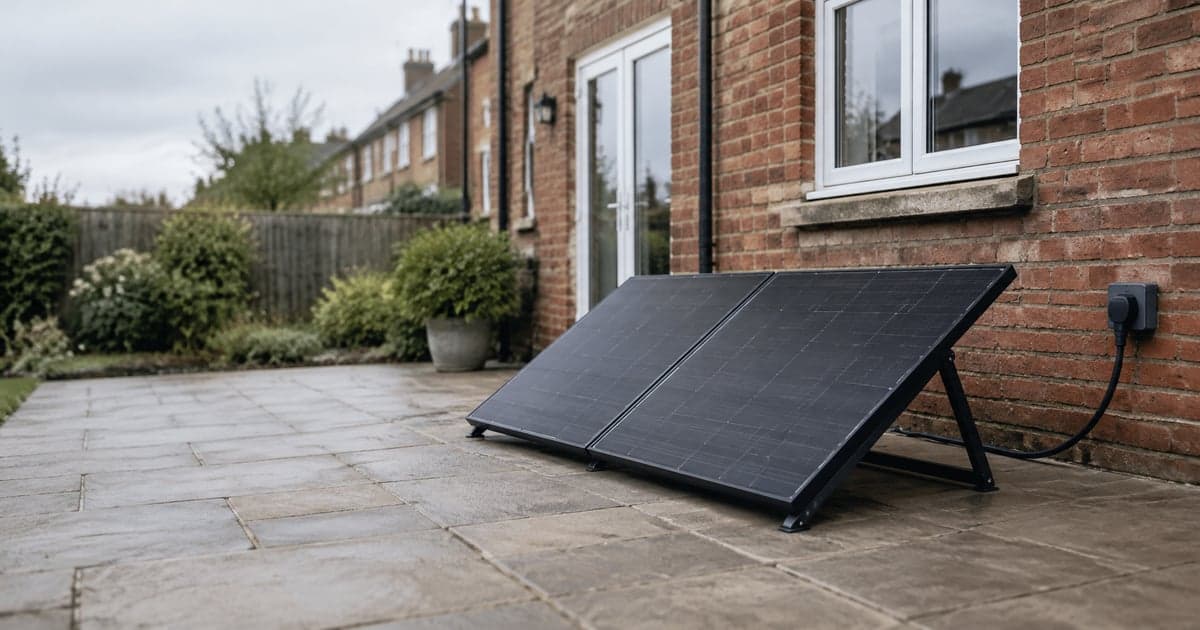
SI 2026/848 (opens in new tab) came into force on 27 August 2026. It amends the Electricity Safety, Quality and Continuity Regulations 2002 to allow a "plug-in microgenerator": a solar device with "a maximum rated alternating current output not exceeding 800 watts" that plugs into an ordinary socket. The 800W limit applies to the inverter, the box that turns the panels' direct current into mains electricity, so the panels behind it can total more: up to 2,000W, under the product specification below.
The kit has to meet the government's Plug-in Solar Device Interim Product Specification (opens in new tab), version 2, which exists because there is no British Standard for plug-in solar yet; the Explanatory Memorandum (opens in new tab) expects one "within around 2-3 years". The specification rules out mounting a kit on a timber balcony or on timber, aluminium composite or high-pressure laminate cladding, and bans plugging one in through a multi-way, travel or RCD adaptor.
Only one kit is allowed per household. The specification allows one per circuit, but the network connection rules Ofgem approved on 11 August 2026 (opens in new tab) cap it at one per home, and the specification says that limit applies. The same rules let the householder act as the installer, so no electrician is needed.
Registering is the one legal duty that follows. Under regulation 22 (opens in new tab) of the 2002 regulations and a Health and Safety Executive exemption, your network operator (the DNO, which runs the cables to your street) has to be told no later than 28 days after you first plug the kit in. The Energy Networks Association runs the form at myplugin.solar, and the government's impact assessment (opens in new tab) expected it to take 5 to 10 minutes.
None of this reaches Northern Ireland. The part of the instrument that permits use extends to England, Wales and Scotland (opens in new tab), and Northern Ireland's own safety regulations, which the impact assessment says would also need reforming, had not been changed by 19 October 2026.
What a kit makes, and what it saves
The impact assessment, from the Department for Energy Security and Net Zero (DESNZ), works through two installations. Both have 800W of panels, average UK sunshine, little or no shading and no battery, at a home that uses 3,323 kWh a year (the 2024 average per domestic meter in Great Britain) with someone in all day:
| DESNZ example | Makes a year | Used at home | Share used |
|---|---|---|---|
| Facing south, tilted at 30° | 690 kWh | 428 kWh | 62% |
| Upright, facing east or west | 378 kWh | 272 kWh | 72% |
Octopus's own range for "a standard 800W kit" is 500 to 800 kWh a year "in optimal conditions", and DESNZ's south-facing case sits inside it.
The "used at home" column decides the payback, because those are the units that replace electricity you would otherwise buy. Each one saves the unit rate (the price per kWh on your bill). On the October to December 2026 price cap (opens in new tab) that averages 26.32p across Ofgem's 14 regions, from 25.36p in the East Midlands to 27.86p in North Wales and Mersey, with no VAT: the government has taken it off electricity from 1 October 2026 to 31 March 2027. If the cap's pre-VAT level held, 5% VAT returning on 1 April 2027 would take the average to 27.64p. A kit does nothing to the standing charge, the fixed daily fee you pay before using anything.
The rest of the output goes to the grid. Octopus pays 12p a unit for it on Outgoing Octopus (opens in new tab), a variable rate it cut from 15p on 1 March 2026, under conditions set out below. None of the other four suppliers checked here offers to pay anything for it. A unit your home uses is therefore worth more than twice a unit you export, and DESNZ's examples assume someone is home all day: a household out at work uses less of the output, which lengthens the payback and sends more of it to the grid.
The payback on Octopus's £650 kit
Octopus's two-panel bundle is two 460W JA Solar panels on a FoxESS inverter rated at 800W in Octopus's own user manual (opens in new tab), and 89% of Octopus's buyers chose it, by Octopus's own count. Its 920W of panel is more than the 800W DESNZ modelled, so on the same roof or wall it makes at least as much as the table below assumes. Payback here is the kit's price divided by what it earns a year:
| £650 two-panel kit | Facing south, tilted at 30° | Upright, facing east or west |
|---|---|---|
| Saved a year at 26.32p, to 31 March 2027 | £112.66 | £71.60 |
| Saved a year at 27.64p, from 1 April 2027 | £118.29 | £75.18 |
| Export at 12p, Octopus only | £31.44 | £12.72 |
| Payback without export, at 26.32p | 5.8 years | 9.1 years |
| Payback without export, at 27.64p | 5.5 years | 8.6 years |
| Payback with export, at 26.32p | 4.5 years | 7.7 years |
| Payback with export, at 27.64p | 4.3 years | 7.4 years |
Facing south, Octopus's two-panel kit pays for itself in under six years on bill savings alone. Upright on an east- or west-facing wall it takes 9.1, and the impact assessment assumes the inverter needs replacing after 10 years, at £100, so the wall-mounted kit clears its cost less than a year before its first repair bill, which is what makes it marginal. DESNZ calls the 10 years "a conservative timeline assumption" and expects integrated microinverter kits to last longer in practice.
Being paid for export takes 1.3 years off the south-facing payback and 1.4 off the wall-mounted one at today's rate. That is £13 to £31 a year, under a third of what the same kit saves on the bill and inside the "max" of £50 a year that Octopus's explainer (opens in new tab) estimates. Octopus's own payback estimate is more cautious than this table: its launch release (opens in new tab) of 28 August put the two-panel kit's payback with a smart export tariff at "five and a half years", against 4.5 here.
Two more things move every figure above. The impact assessment expects one home in five to need minor electrical work at £200, which adds 1.8 years to the south-facing payback. And your region's rate, 25.36p to 27.86p, shortens or lengthens each payback by under 6%.
The £450 single-panel kit is one of the same panels on the same inverter, so DESNZ's examples describe the pair rather than it. The extra £200 buys the second panel, and because the pair shares one 800W inverter, the second panel adds at most half of what the kit makes. Used at home, that output is worth 26.32p a unit; exported to Octopus, 12p; exported from a home on any other supplier checked here, nothing. In DESNZ's examples the installation making less uses a larger share of it (72% against 62%), so the second panel's output is the likeliest to end up on the grid.
Does your supplier pay for what it exports?
Rooftop solar is paid for its surplus through the Smart Export Guarantee (SEG), the Ofgem scheme under which suppliers offer a tariff for the electricity small generators send to the grid. Ofgem's guidance (opens in new tab) asks solar installations up to 50kW to show certification under the Microgeneration Certification Scheme (MCS) or an equivalent, and says a supplier "is not obliged to offer payments" without it, though it "can make payments if they wish". MCS said on 14 September 2026 (opens in new tab) that plug-in solar, as a do-it-yourself system, "is not included in the scope of MCS". So no supplier has to pay for a plug-in kit's export, and on 19 October 2026 the five checked here had each decided differently:
| Supplier | Sells a plug-in kit | Pays for a plug-in kit's export |
|---|---|---|
| Octopus (opens in new tab) | Yes: £450 for one 460W panel, £650 for two, both sold out on 19 October | Yes, 12p a unit on Outgoing Octopus, for a kit bought from Octopus at a home Octopus supplies with electricity, with a working smart meter |
| British Gas (opens in new tab) | Not yet: a register-interest form, with no price | Not yet: it is "currently working to make this possible" |
| EDF (opens in new tab) | No: it is sticking with rooftop solar "rather than entering the plug-in solar market" | No: its guide says plug-in owners can't "earn money through Smart Export tariffs" |
| E.ON Next (opens in new tab) | No: none of its solar, export or terms pages mentions plug-in solar | Not stated, and every E.ON Next export tariff asks for an MCS or Flexi-Orb certificate |
| OVO (opens in new tab) | Not yet: on 27 August it promised "a full plug-in solar offer to customers in the coming months" | No: "There is no export and no feed-in payment" |
Two of those answers are moving. British Gas's parent company, Centrica, said on 27 August (opens in new tab) that customers could be paid for the electricity they export "in the next few weeks"; seven and a half weeks later its own export page still said it was working on it. Its export tariff currently pays its own electricity customers 12p a unit and everyone else 3p, for installations with an MCS, Flexi-Orb or accreditation certificate. And E.ON completed its purchase of OVO (opens in new tab) on 8 October 2026, so OVO's promised plug-in offer is now E.ON's to launch.
Buy Octopus's kit while another company supplies your electricity, and Octopus says you'll need to set up an export tariff with your current supplier; none of the other four in the table above offers one for a plug-in kit.
Octopus's condition: its kit, and its electricity supply
Octopus's explore page (opens in new tab) sets it out in two lines: "You buy Plug-in Solar from us AND we supply your home energy" gets you Outgoing Octopus, and "You buy your Plug-in Solar elsewhere: You won't be able to sign up for an Octopus export tariff for that system." Its set-up guide (opens in new tab) adds that you must be "on supply with us for your electricity", that there is "no additional charge" to join, and that exporting can take around six weeks to start once you apply, about four of them while your DNO creates an export MPAN (the reference number your exported units are recorded against). You can apply only after registering the kit with the Energy Networks Association and getting your DNO's approval, so the time that approval takes comes on top.
That makes export the only reason a plug-in kit gives you to switch supplier, and only if the kit is Octopus's. The switch pays more up front than a year of that export: £50 in bill credit for you and £50 for whoever referred you, after your first Direct Debit, on the Octopus Energy referral link. It costs nothing in unit rate on Flexible Octopus, whose electricity unit rates sat within 0.005p of the cap in all 14 regions on 13 October 2026, with standing charges 0.39p to 1.53p a day below it.
One Octopus figure doesn't survive the arithmetic. Its 1 October press release (opens in new tab) says plug-in customers are "pocketing roughly £150 a year on Octopus's Outgoing export tariff". At 12p a unit, £150 is 1,250 kWh of export, more than half as much again as the 800 kWh a year Octopus says a kit makes at best. The release's own footnote calls the £150 "an estimated annual saving", and the explainer's £50 is the export figure that fits.
What Octopus's pages don't settle
Delivery dates disagree. Octopus's explore page says the kits "will be available for delivery by the end of September 2026" and also that they "will be delivered throughout October and November", then gives a schedule by order date running to the end of November; its shop page says "throughout September and October". Both bundles showed as sold out on 19 October.
No warranty term appears on the explore page, the shop page, the set-up guide, the explainer or either of the two user manuals.
Octopus's Smart Tech referral (opens in new tab) pays a £100 gift voucher to each side when a friend installs a heat pump or solar system, and neither its page nor its terms mention plug-in kits. Whether a kit counts is unconfirmed, so none of the figures above include it.
Plug-in solar FAQs
Are plug-in solar panels legal in the UK?
In Great Britain, yes, since 27 August 2026. SI 2026/848 lets a solar device with an inverter output of up to 800W plug into an ordinary socket, provided it meets the government's interim product specification. The network connection rules allow one per household, and it has to be registered with the local network operator within 28 days of first use. The part of the law that permits use extends to England, Wales and Scotland only; Northern Ireland would need its own safety regulations changed, and had not changed them by 19 October 2026.
How many watts can a plug-in solar kit be?
800W of output from the inverter, which is the limit SI 2026/848 sets. The panels behind it can total up to 2,000W under the government's interim product specification, which also tells manufacturers to advise a professional check of your wiring above 960W of panel. Octopus's two-panel kit is 920W of panel on an 800W inverter.
Do I need to register a plug-in solar panel?
Yes. Your local network operator has to be told no later than 28 days after you first plug the kit in, and you can do it yourself through the Energy Networks Association's registration site, myplugin.solar, which only lists approved devices. If you move house and plug the kit in at the new address, you register it again there.
Can a plug-in solar kit get the Smart Export Guarantee?
Not as a right. Ofgem's guidance lets a supplier refuse SEG payments for a solar installation without an MCS certificate or equivalent, and MCS says plug-in solar is outside its scope. A supplier can still choose to pay: on 19 October 2026 Octopus did, on kits it sold to homes it supplies with electricity, and British Gas, EDF, E.ON Next and OVO did not offer to.
Does a plug-in solar panel need a smart meter?
Not to work: the kit powers whatever is running in the home as it generates, which is where its savings come from. To be paid for what it exports, yes. Octopus asks for a working smart meter, and every export tariff checked here needs a meter that records export every half hour.
Where these numbers came from
All read on 19 October 2026.
- The law: SI 2026/848 (opens in new tab), its extent provision (opens in new tab) and Explanatory Memorandum (opens in new tab); regulation 22 (opens in new tab) of the 2002 regulations; the interim product specification (opens in new tab), version 2; and Ofgem's approval (opens in new tab) of the one-per-household connection rule
- Generation, the share used at home, the inverter's life and the cost of electrical work: DESNZ's final impact assessment (opens in new tab), Table 7 and the evidence base. DESNZ valued its examples on the July to September 2026 cap; the savings above re-value the same units on October's
- Unit rates: Ofgem's regional cap rates (opens in new tab) for 1 October to 31 December 2026, single-rate meter, Direct Debit, as billed with 0% VAT. The 26.32p is the unweighted mean of the 14 regions, and 27.64p adds 5% VAT to it. Flexible Octopus's rates are from Octopus's public tariff API, read on 13 October 2026
- Export: Outgoing Octopus (opens in new tab) and its rate history in Octopus's public tariff API; Ofgem's SEG guidance (opens in new tab); MCS's statement (opens in new tab) on plug-in solar
- Octopus's kit, prices, stock and conditions: its explore page (opens in new tab), shop (opens in new tab), set-up guide (opens in new tab), explainer (opens in new tab), user manual (opens in new tab), and its 28 August (opens in new tab) and 1 October (opens in new tab) press releases
- The other four suppliers: British Gas's plug-in guide (opens in new tab) and export tariff (opens in new tab), and Centrica's 27 August release (opens in new tab); EDF's plug-in guide (opens in new tab) and export tariffs (opens in new tab); E.ON Next's export tariffs (opens in new tab); OVO's 27 August release (opens in new tab), export tariffs (opens in new tab) and 8 October release (opens in new tab)
- Referral terms: Octopus Energy referral code, last tested 13 October 2026, and Octopus's Smart Tech referral (opens in new tab)
- I own no plug-in kit and my electricity is with EDF, so none of this is measured on a real installation

Referral Plug founder · Personal finance writer and UK consumer savings specialist
I specialise in finding people the best deals to cope with the ever-increasing cost of living. I like to review companies from everyday industries like banking and energy and try to provide a fresh mix of facts and unbiased opinions.
Last verified: October 2026