
Published · 10 minute read
Yonder points value 2026: what are Yonder points really worth?
Ad Links marked Ad are my referral links.
TL;DR
A Yonder point is worth 0.1p cashed out, 0.16p against a flight, and 0.339p across my own four redemptions. Yonder markets “up to 2.5p”; its app and most UK reviews use 0.5p. So 10,000 Yonder points is £10 as statement credit, about £16 towards a flight, and about £34 at the rate I actually achieve. It is not £50. Here is every published rate, its source, and the arithmetic behind it.
If you just need the link, you can get your Yonder referral code here.
Affiliate disclosure: this post contains a Yonder referral link, and I hold a Yonder Premium card, called Full until September 2026. I receive points if you join through it. That is a reason to read the sourcing below rather than take my word for anything, which is why every rate on this page is either cited to Yonder’s own documents or drawn from my own redemption history.
Short answer: a Yonder point is worth 0.1p if you cash it out, 0.16p against a flight, and 0.339p across my own four redemptions. Yonder markets “up to 2.5p towards an Experience”, its app values a balance at 0.5p, and most UK reviews repeat 0.5p. So 10,000 Yonder points is £10 as statement credit, about £16 towards a flight, and about £34 at the rate I have actually managed. The widely repeated “10,000 points is £50” is five times the only rate Yonder guarantees in writing.
There are at least eight answers in circulation to “how much is a Yonder point worth”, and four of them come from Yonder itself. That is not a rounding disagreement: the highest published figure is twenty-five times the lowest. This page collects every one of them, says where it came from, and works out what each means in pounds.
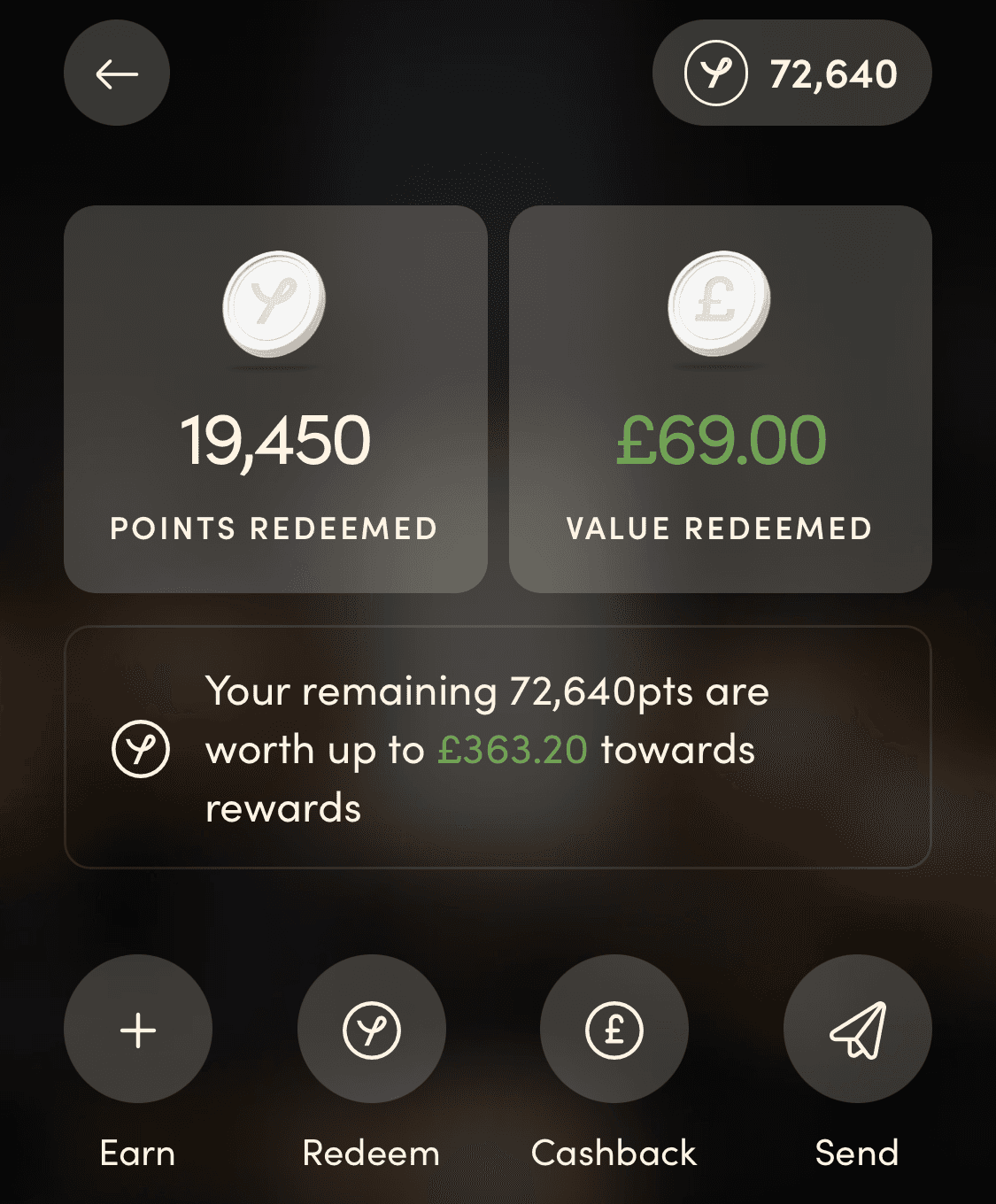
That screen, captured 25 July 2026, is the whole problem in one frame. The left half is measured: 19,450 points had gone out and £69.00 had come back, which is 0.355p per point. The right half is a projection at 0.5p, a rate the account on the left had never achieved. Two weeks later I spent 51,720 of those points on a knife set. The projection said they were worth £258.60. They returned £172.00.
Every Yonder point value in one table
| Value per point | Where the number comes from | How it is verified |
|---|---|---|
| 2.5p | Yonder’s marketing: “up to 2.5p towards an Experience” | Yonder Rewards (opens in new tab) |
| 0.5p | Yonder’s app, valuing my 72,640-point balance at £363.20 | My account, 25 July 2026 |
| 0.5p | The figure most UK reviews settle on | Published reviews, cited below |
| 0.4p | My best single redemption (£25 of coffee for 6,250 points) | My redemption ledger |
| 0.339p | My blended rate across all four redemptions | My redemption ledger |
| 0.333p | My largest single redemption (£172 off a knife set for 51,720 points) | My redemption ledger |
| 0.16p | Money off a flight: 31,250 points covers £50 | Yonder Flights (opens in new tab), rate via Finder (opens in new tab) |
| 0.1p | Statement credit: “100,000 Points is worth £100” | Rewards Terms 2.3 (opens in new tab), section 4(b) |
| Where the number comes from | Value per point | vs my rate |
|---|---|---|
| Yonder’s marketing, “up to 2.5p” | 2.5p | 7.4× |
| Yonder’s app, valuing my balance | 0.5p | 1.5× |
| What most UK reviews repeat | 0.5p | 1.5× |
| What I’ve actually achieved, four redemptions | 0.339p | my rate |
| The knife set I redeemed, 51,720 pts for £172 | 0.333p | 1.0× |
| Against a flight, 31,250 pts for £50 | 0.16p | 0.5× |
| Cashing out, the only rate in writing | 0.1p | 0.3× |
Source: Yonder, September 2026. Seb Place, Yonder app, August 2026. Seb Place, survey of UK Yonder reviews, July 2026. Seb Place, Yonder redemption ledger (71,170 points for £241.00), August 2026. Yonder Rewards Terms & Conditions 2.3, section 4(b), September 2026.
Only the bottom row is a rate Yonder has committed to in writing. Three rows, 0.4p, 0.339p and 0.333p, are money that actually reached me. Everything else is a marketing ceiling, an app projection, or a figure repeated from somewhere else.
Yonder’s own card pages sit in the bottom half of that table. The rewards calculator on its Premium card page (opens in new tab) values points at 0.1p for cashback, 0.16p for flights, 0.38p for dining, 0.4p for entertainment, 0.46p for shopping and 0.5p for lounges, read from the page’s code on 22 September 2026. Nothing in it reaches the 2.5p still printed on Yonder’s rewards page. Its new claim that Premium is “worth £870 a year” reconciles, to within £1, at 0.4p a point, once the travel insurance and travel credits are counted at Yonder’s own £275 and £140.
What 10,000 Yonder points is actually worth
The welcome offer is usually quoted in points, so this is the conversion most people actually need. Every column is the same points balance valued at a different published rate.
| Points | Cash out (0.1p) | Flight (0.16p) | My real rate (0.339p) | “Everyone says” (0.5p) | Yonder’s ceiling (2.5p) |
|---|---|---|---|---|---|
| 1,000 | £1 | £1.60 | £3.39 | £5 | £25 |
| 10,000 | £10 | £16 | £33.90 | £50 | £250 |
| 20,000 | £20 | £32 | £67.80 | £100 | £500 |
| 31,250 | £31.25 | £50 | £105.94 | £156.25 | £781.25 |
| 100,000 | £100 | £160 | £339 | £500 | £2,500 |
One caveat on the flight column: it is a rate, not an achievable redemption at every size. Yonder sells flight credit in fixed blocks of £50, £100 and £200, so 10,000 points cannot be put towards a flight at all. The £16 is what 10,000 points would be worth if you could, and it is there to make the rate comparable across the table.
The 31,250 row is the one worth staring at. That is exactly enough for £50 off a flight, and it is the point total where the flight route is unambiguously the second-worst thing you can do with your points. The same balance is worth about £106 at the rate I actually achieve on the rewards catalogue.
The 100,000-point prize draw, priced honestly
Yonder’s referral screen offered referrers “a chance to win 100,000 points”, at a stated 1% chance per eligible referral, when I checked my own screen on 24 July 2026. It was gone when I re-checked on 1 August 2026, which is itself the point: Yonder runs the draw only some of the time and sets referral terms per member. The arithmetic is worth keeping, because the pattern it illustrates recurs every time a rewards brand quotes a five-figure prize. Run it through the table.
- The headline number, read at Yonder’s marketed 2.5p, looks like £2,500.
- At the only rate guaranteed in writing, 100,000 points is £100.
- At a 1% chance, the expected value of an eligible referral’s prize entry is therefore about £1, or about £3.39 if you value the points at my measured rate.
Nothing about that is dishonest on Yonder’s part: the odds are stated and the maths is simple. But it is a clean illustration of the pattern this whole page is about, which is that a large points number and a large amount of money are not the same thing.
Where does the “10,000 points is £50” figure come from?
Yonder’s own rewards page contains the seed of it, in a worked example that does not survive its own arithmetic:
if you’re spending £1,250 each month, you’ll earn 75,000 yonder points each year. When used at 2.5p towards Experiences, you’ll get back around £375 in value
75,000 points at 2.5p is £1,875. £375 is 75,000 points at 0.5p. One sentence, two rates, five times apart, and the smaller one is presented as the result of the larger one.
The 0.5p then propagates. More Points (opens in new tab) (June 2024) writes that “2 points are worth a little under 1p when used at good value redemptions” and prices the annual fee at 32,000 points, “valuing the points at 0.5p”. Thrifty Points (opens in new tab) (June 2025) describes the welcome bonus as “10,000 points (worth £50 as cash, or up to £250 at Experiences)”, then later in the same article states the cash rate correctly: “redeem points as a credit against your card balance at a fixed rate of 0.1p per point”. Both sentences are in one review. Ten thousand points as cash is £10, not £50, by the article’s own figure.
I am not picking on either site. Both are careful publications, and the second one printed the right number two paragraphs from the wrong one. That is the tell: this is not sloppiness, it is what happens when a brand publishes four different rates and lets readers pick. The consensus figure is not a lie anyone told, it is an average of a marketing ceiling and a contractual floor, and it does not describe any redemption you can actually make.
The unit trap that makes every review look wrong
The other reason published Yonder numbers look incompatible is that they are not all measuring the same thing. Three different units are in use, and reviews rarely label which one they mean:
- Pence per point. What one point is worth. This is the unit this page uses throughout.
- Pence per pound spent. Value per £1 you put through the card. On Premium that is five times the per-point rate, because Premium earns 5 points per £1.
- Percentage back. The same as pence per pound spent, expressed as a percentage.
So the same redemption rate produces wildly different-looking headlines depending on the card tier and the unit:
| Value per point | Yonder Premium (5 points per £1) | Yonder Free (1 point per £1) |
|---|---|---|
| 2.5p | 12.5% back | 2.5% back |
| 0.5p | 2.5% back | 0.5% back |
| 0.339p | 1.695% back | 0.339% back |
| 0.16p | 0.8% back | 0.16% back |
| 0.1p | 0.5% back | 0.1% back |
Every figure in that table is defensible and several are in print. “Up to 12.5% back” and “0.5% cashback” are the same card, the same points, and a difference only in redemption route. When you read a Yonder review, check whether the number is per point or per pound before comparing it to anything. Pence per pound spent is the unit that makes two different cards comparable at all, and it is the one the main UK rewards currencies are converted into here.
0.1p: the only rate Yonder guarantees in writing
Yonder’s Rewards Terms and Conditions 2.3 (opens in new tab), section 4(b), states it plainly: “100,000 Points is worth £100”. That is 0.1p per point, and it is the one conversion rate Yonder commits to contractually. Everything above it depends on a catalogue Yonder curates and can change.
Two conditions attach to it:
- It is Premium members only. The same section says that if you are a Free member, “you can’t redeem your Points for a cash equivalent amount”. Free members have no floor at all.
- It is the worst rate available. Cashing out gives up 71% of the value I have achieved by redeeming on the catalogue, and 96% of Yonder’s marketed ceiling.
If you plan to cash out rather than redeem, that single fact settles the tier question: at 0.1p, four extra points per £1 is worth 0.4p, and Premium’s £215.88 a year at £17.99 a month needs about £54,000 of annual card spending to recover. Free is the right card at any spend level, and the full Free versus Premium comparison is in my Yonder review.
0.16p: what a flight actually costs in points
Yonder lets Premium members put points towards any flight, with any airline, booked directly. Yonder’s flights page (opens in new tab) confirms the structure: “You can choose to redeem points up to three different amounts; £50, £100 and £200”, with “no blackout dates” and no transfer partners, but you must “purchase your tickets directly with the airline”. It is a Premium benefit; Free members cannot use it.
The point cost of each block, reported by Finder (opens in new tab) in June 2024 and matching what my own app shows:
| Flight credit | Points required | Value per point |
|---|---|---|
| £50 | 31,250 | 0.16p |
| £100 | 62,500 | 0.16p |
| £200 | 125,000 | 0.16p |
There is no volume discount: the rate is flat at 0.16p across all three tiers. That is worth knowing because points programmes usually reward larger redemptions, and this one does not.
Flight credit is genuinely more flexible than Avios, since there is no award availability to chase and no route restrictions. It is also 53% worse per point than what I get from the rewards catalogue. Flexibility has a price here and it is a steep one. I have not redeemed against a flight myself, so this rate is from Yonder’s published tiers rather than my ledger.
0.339p: what I actually got across four redemptions
This is the only number on the page that comes from money actually received. Four redemptions between December 2025 and August 2026:
| Date | Partner | Points spent | Value received | Rate achieved |
|---|---|---|---|---|
| 9 Dec 2025 | Le Creuset | 7,200 | £20.00 | 0.278p |
| 31 Dec 2025 | Origin Coffee | 6,250 | £25.00 | 0.400p |
| 24 May 2026 | Origin Coffee | 6,000 | £24.00 | 0.400p |
| 9 Aug 2026 | Allday Goods | 51,720 | £172.00 | 0.333p |
| Total | 71,170 | £241.00 | 0.339p |
Three things about that ledger which matter for how far you should trust the figure.
It is all physical goods. Two coffee orders, a set of Le Creuset mugs and a set of kitchen knives. I have never booked a dining Experience, which is the flagship use case and the only route Yonder attaches the 2.5p ceiling to. So 0.339p is an honest measurement of the part of the catalogue I use, and it is not a measurement of Experiences. If you will genuinely use the restaurant side, your rate could be higher than mine, and I have no firsthand basis to tell you by how much.
My ceiling was 0.4p, not 2.5p. Both best redemptions landed at exactly 0.4p, and the largest one, the knife set, priced at 0.333p. Nothing in my account has come within five times of the marketed rate.
It is four redemptions, not thirty, and one of them dominates. The knife set is 73% of every point I have ever spent, so the blended rate is now mostly a measurement of that single transaction. It is still four more real redemptions than most published Yonder valuations are built on, and it is the number I use for every piece of Yonder maths on this site, including the Premium versus Free breakeven of about £1,330 a month.
What a points valuation never captures
Every rate on this page assumes you redeem. Three things quietly reduce the real value below whatever number you settle on.
Points are forfeited if the account closes. Rewards Terms section 7(a): “If you or we close your account in accordance with the terms of the Account Terms or the Credit Agreement, you will lose any Points that you have earned.” Points do not expire while the account is open, but the exit price is total. A large idle balance is a reason to redeem, not a reason to feel wealthy.
Rewards carry their own expiry dates. Individual items in the catalogue are time-boxed, and some are marked Beta. The reward you are saving towards may not exist by the time you can afford it. The knife set was marked “available until 31 Jul” and I redeemed it on 9 August, so that date proved soft, but a catalogue that can move a date in your favour can move one against you. This is inherent to a curated catalogue rather than a fault, and no fixed points valuation prices it.
Redemption takes effort you may not spend. It took me eight months to redeem 71,170 points, and 51,720 of them went in one transaction after months of meaning to get round to it. The day after that transaction the balance read 36,715 again, and every one of those points is worth 0p until I redeem them too. A cashback card pays you whether or not you remember it exists, which is the strongest argument against rewards cards generally and the one most reviews skip.
How do you work out what your own Yonder points are worth?
Ignore every published figure, including mine, and use your own account. The method takes two minutes:
- Open the Yonder app and go to your rewards history.
- Add up every point you have redeemed, across all redemptions.
- Add up the pound value you received for them.
- Divide the pounds by the points, then multiply by 100. That is your rate in pence per point.
For me: £241.00 ÷ 71,170 points × 100 = 0.339p.
Then use your own rate, not Yonder’s, for the only decision that depends on it. Premium earns four extra points per £1 over Free. Multiply four by your rate to get the extra pence you earn per £1 of spending, then divide 21,588p, which is Premium’s £215.88 annual cost at £17.99 a month in pence, by that to find the annual spend in pounds at which Premium starts paying for itself. At 0.339p that is about £15,900 a year, or £1,327 a month. At 0.5p the same sum returns £900 a month, which is why the inflated rate matters: it tells everyone spending between £900 and £1,330 a month to buy a card that will lose them money.
If you have never redeemed anything, you do not have a rate yet. Use 0.1p, because that is the only number Yonder has promised you.
Yonder points value FAQs
How much is a Yonder point worth?
About 0.339p in practice, measured across my own four redemptions totalling 71,170 points for £241.00 of rewards. The only rate guaranteed in Yonder’s Rewards Terms is 0.1p, where 100,000 points converts to £100 of statement credit for Premium members. Flight redemptions are 0.16p, since 31,250 points covers £50 off a flight. Yonder markets points at “up to 2.5p towards an Experience”, and its app values a balance at 0.5p.
What is 10,000 Yonder points worth?
£10 as statement credit, which is the only figure Yonder guarantees. About £16 towards a flight at Yonder’s published rate, though flight credit is only sold in £50, £100 and £200 blocks so 10,000 points cannot buy one on its own. About £34 at the 0.339p I have actually achieved on the rewards catalogue. It is widely reported as £50, which uses a 0.5p rate that no Yonder document commits to.
Are Yonder points worth 0.5p each?
Not on any redemption I have made. The 0.5p figure comes from Yonder’s own app, which values a points balance at that rate, and from a worked example on Yonder’s rewards page that quietly uses 0.5p while attributing the result to 2.5p. Most UK reviews have adopted it. My measured rate across four real redemptions is 0.339p, and the only contractual rate is 0.1p.
What is the best value way to redeem Yonder points?
The rewards catalogue, by a wide margin over the alternatives. Across my redemptions it returned 0.339p per point against 0.16p for flight credit and 0.1p for statement credit. Cashing out is the worst option available and gives up roughly 71% of the value I have achieved by redeeming on rewards. Yonder attaches its “up to 2.5p” ceiling to Experiences specifically, which I have not tested.
Can Yonder Free members cash out points?
No. Rewards Terms section 4(b) states that Free members cannot redeem points for a cash equivalent amount. Statement credit at 0.1p and flight redemptions are both Premium-only benefits, so Free members are limited to the rewards catalogue.
Do Yonder points expire?
Not while your account is open. They are lost entirely if the account closes: Rewards Terms section 8(a) says you lose any points you have earned if you or Yonder close the account. So there is no deadline pressure, but there is a total loss at exit, which is a good reason to redeem a large idle balance rather than sit on it.
Is the Yonder welcome bonus worth £100?
The current Premium welcome offer of up to 20,000 tiered points is worth £20 as statement credit, about £68 at my measured redemption rate, and £100 only if you accept the 0.5p figure. Note that Yonder’s card pages advertise the same welcome points to everyone; what a referral adds on Premium, against that public offer, is a second fee-free month, worth £17.99, and £10 off your first purchase. Referral terms are set in the app, are personal to each member and change, so check what your own application screen shows.
The bottom line
A Yonder point is worth 0.1p guaranteed, 0.16p on a flight, and 0.339p in my hands. Pick whichever of those describes what you will actually do, and ignore the rest.
The 0.5p consensus is not malicious, it is the midpoint of a marketing ceiling and a contractual floor, and it happens to be roughly 50% higher than what I get and five times what Yonder promises. It matters because it is the number people use to decide whether to pay £17.99 a month for Premium, and at 0.5p that decision looks good from £900 a month of spending, while at my real rate it does not pay until about £1,330.
None of this makes Yonder a bad card. I hold Premium (formerly Full), I rate it 4.5 out of 5, and I keep paying for it because I spend enough to clear the bar and I actually redeem. It makes Yonder a card whose points are worth about a seventh of what the marketing implies, which is a different sentence and a more useful one.
The full ledger, the tier maths and the verdict are in my Yonder review, every route is ranked and worked through in how to redeem Yonder points for the most value, and there is a card-versus-card comparison in Yonder vs Amex Gold. If you have already decided, the Yonder referral offer is here.
Sources
- Yonder Rewards Terms & Conditions 2.3 (opens in new tab), which renames Full to Premium and leaves section 4(b) unchanged since the 2.0 document first cited here: section 4(b), “100,000 Points is worth £100” and the Free-member cash-out exclusion; section 8(a), points lost on account closure
- Yonder Premium Credit Card (opens in new tab): the rewards calculator’s per-category rates, read from the page’s code, and the “worth £870 a year” claim, 22 September 2026
- Yonder Rewards (opens in new tab): the “up to 2.5p towards an Experience” claim and the £1,250-a-month worked example
- Yonder Flights (opens in new tab): the £50, £100 and £200 redemption blocks, Premium-member eligibility, and the book-direct requirement
- Finder: get up to £200 off any flight via credit card points (opens in new tab) (Michelle Stevens, 12 June 2024): 31,250 points covers £50 off a flight, 62,500 covers £100, 125,000 covers £200
- More Points: Yonder card review (opens in new tab) (16 June 2024): “2 points are worth a little under 1p”, and the fee priced at 32,000 points “valuing the points at 0.5p”
- Thrifty Points: Yonder credit card review (opens in new tab) (27 June 2025): “10,000 points (worth £50 as cash, or up to £250 at Experiences)” alongside “a fixed rate of 0.1p per point”
- My own Yonder account: redemption history and rewards balance, captured 25 July 2026; the Allday Goods redemption of 51,720 points for £172.00, transacted and captured 9 August 2026; balance of 36,715 points, 10 August 2026; referral screen captured 24 July 2026 including the 1% prize draw, and re-checked 1 August 2026 with the draw withdrawn and a five-purchase condition added to the referrer’s reward

Referral Plug founder · Personal finance writer and UK consumer savings specialist
I specialise in finding people the best deals to cope with the ever-increasing cost of living. I like to review companies from everyday industries like banking and energy and try to provide a fresh mix of facts and unbiased opinions.
Last verified: September 2026
Griffin Bank Limited, which holds the money on Yonder debit cards, is incorporated in England and Wales (No. 10842931), authorised by the Prudential Regulation Authority and regulated by the Financial Conduct Authority and the Prudential Regulation Authority (FRN 970920). Its paid up capital and reserves exceed £10 million.
Eligible deposits are protected by the Financial Services Compensation Scheme, and eligible complaints can go to the Financial Ombudsman Service.